Social Network
The Psychology of Making Friends as an Adult
Learn the psychology of making friends as an adult, why friendships can be harder to build, and practical tips for creating meaningful, lasting connections onli
- Yaarzo
- adult friendship
- making friends as an adult
- psychology of friendship
- adult friendships
- friendship psychology
- making new friends
- social connection
- meaningful friendships
- building friendships
Somewhere between your mid-twenties and now, making friends quietly turned from "easy" to "exhausting." You used to meet people in class, at parties, in dorm hallways — friendship just happened. Now it takes effort, planning, and a strange kind of courage that nobody warned you about. This isn't a personal failing. It's psychology, and once you understand what's actually going on in your brain, making adult friendships gets a lot less intimidating.
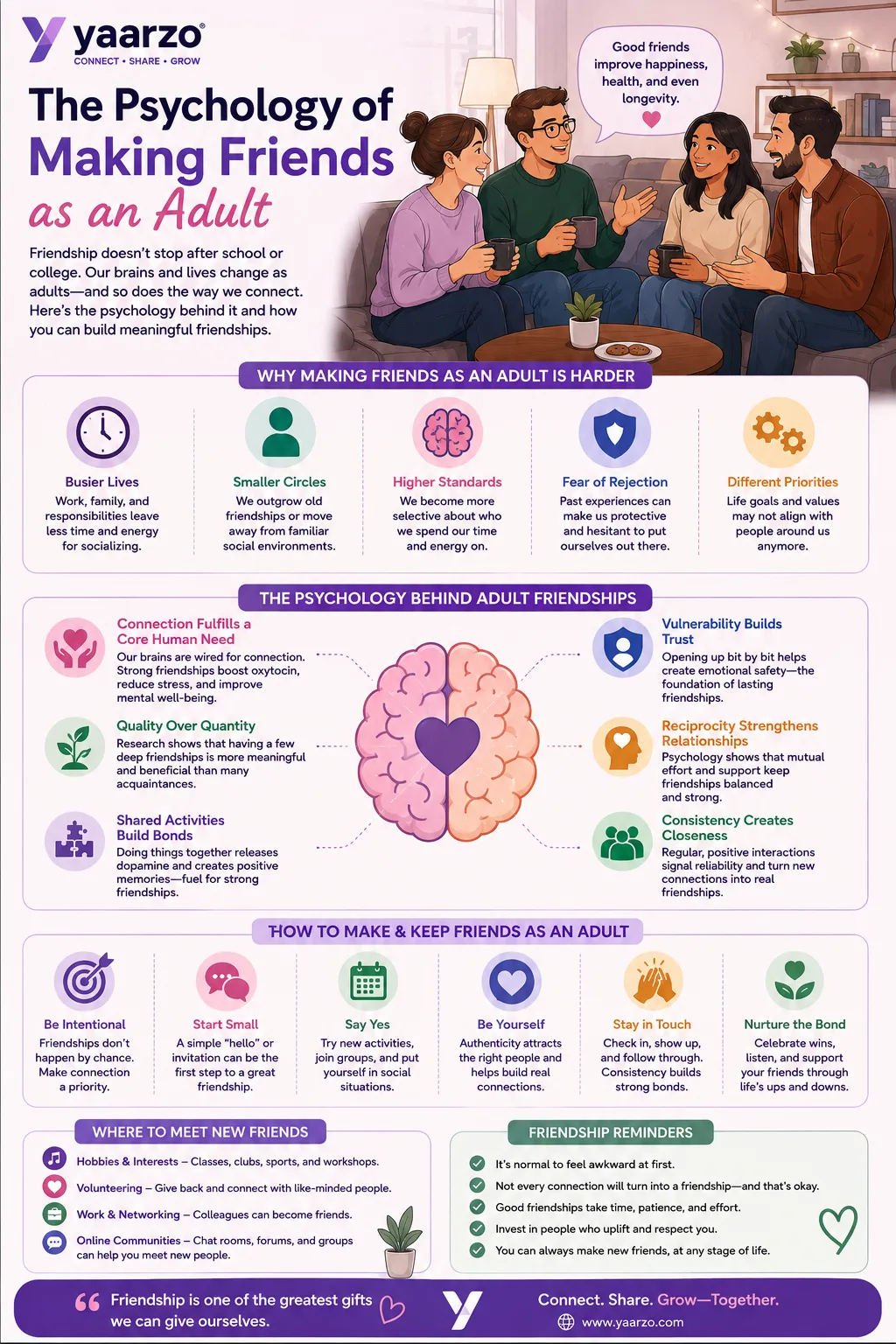
Why Making Friends as an Adult Feels So Hard
Researchers who study adult friendship point to something called the "proximity and repetition" model — the idea that closeness forms through repeated, low-stakes contact over time. Think about how you became friends with people in school: you saw them five days a week for years, whether you meant to or not. Adulthood removes that scaffolding entirely. No shared classroom, no dorm hallway, no guaranteed repetition. You have to build the structure yourself, and that feels unnatural because it is unnatural, at least compared to how friendship worked for most of human history.
The "Familiarity Threshold" Nobody Talks About
A widely cited study from the University of Kansas found it takes roughly 50 hours of time together to move from acquaintance to casual friend, and around 200 hours to become close friends. That's not a weekend. That's months of consistent, repeated hangouts — which explains why one great coffee date rarely turns into a real friendship on its own. Adults often give up after one or two interactions, assuming a lack of instant chemistry means it won't work. Psychologically, that's backwards. Friendship is built on accumulated familiarity, not a single spark.
The Fear of Rejection That Keeps Adults Isolated
Here's an uncomfortable truth: most adults overestimate how awkward they'll seem and underestimate how much other people actually want connection. This is called the "liking gap," a term coined by psychologists Erica Boothby and Gus Cooney. Their research showed that after conversations between strangers, both people consistently underestimated how much the other person enjoyed talking to them. In plain terms — you're probably liked more than you think, and so is everyone else quietly hoping someone reaches out first.
This fear compounds with age because the stakes feel higher. As a kid, rejection stung for a day. As an adult, it can feel like proof that something is wrong with you. It isn't. It's just a mismatch of timing, energy, or circumstance, and reframing it that way removes a lot of the pressure from that first awkward message or invitation.
How to Make Friends as an Adult Without Feeling Awkward
The good news is that friendship psychology also hands you a shortcut: consistency beats charisma. You don't need to be the most interesting person in the room. You need to show up again.
Pick one recurring activity — a class, a run club, a game night — instead of chasing one-off events. Repetition builds the familiarity that spontaneity can't.
Say the quiet thing out loud. Adults respond well to directness, like "I'm trying to meet more people, want to grab coffee sometime?" It signals intent instead of vague politeness.
Lower the stakes of the first interaction. A 20-minute chat is easier to agree to than a three-hour dinner, and it still counts toward that familiarity threshold.
Follow up within 48 hours. Momentum fades fast; a quick message after meeting someone keeps the connection warm instead of letting it go cold.
If in-person options feel limited right now, digital spaces can genuinely fill the repetition gap. A well-designed community chat for making friends lets you talk to the same people regularly, which mimics exactly the kind of low-stakes, repeated contact psychologists say friendship depends on.
Where to Meet New Friends When Your Social Circle Feels Small
Adults often assume friendship requires a "natural" setting like work or a shared hobby group. Sometimes it does. But psychology also supports the idea of "weak ties" — casual, less intense connections — as a legitimate and often underrated path to friendship. Sociologist Mark Granovetter's classic research on weak ties showed that looser connections frequently open doors that close friends can't, simply because they exist in different circles than you do.
Online Spaces Count Too
There's still a stigma around meeting friends online, but that's fading fast, especially since remote work and shifting cities have scattered people's social networks. Online chatrooms and community platforms offer something in-person life often can't: consistent, low-pressure access to people who are also actively looking to talk and connect, not just passively scrolling. If you're rebuilding a social circle from scratch, you can sign up on Yaarzo and start with a genuinely simple format — real conversations, no swiping, no pressure to perform.
Building Friendships That Actually Last Past the First Conversation
Making an initial connection is only half the psychology. The other half is sustaining it, and this is where most adult friendships quietly die — not through conflict, but through neglect. Life gets busy, messages go unanswered, and the friendship fades by default rather than by choice.
Behavioral scientists describe this as the difference between "high-intensity, low-frequency" contact and "low-intensity, high-frequency" contact. Adults tend to default to the first — big catch-up dinners every few months — when the second actually builds stronger bonds. A short check-in text every week does more for a friendship's longevity than one long dinner every quarter. It keeps you present in someone's life instead of reappearing as a surprise.
Making friends as an adult was never going to feel as effortless as it did at seven years old on a playground. But it's not mysterious, either. It's a matter of understanding a few psychological patterns, lowering the stakes, and showing up consistently — even when, especially when, it feels a little uncomfortable at first.